From IPO to Singularity: what came after the bell.
The IPO was chapter one. Two hours with Peter Diamandis at Singularity University was chapter two. Here's what I keep going back to.
People who know me from the public-company chapter tend to ask the same question: "What did you do after the IPO?"
The honest answer is that the IPO was never the destination. It was the credential. The credential opened a door — and what I walked into mattered far more than the door itself.
The door I walked into was Singularity University in Mountain View, sitting in a small executive program room with Peter Diamandis and Ray Kurzweil. Two hours, no agenda, no deck. Just operators.
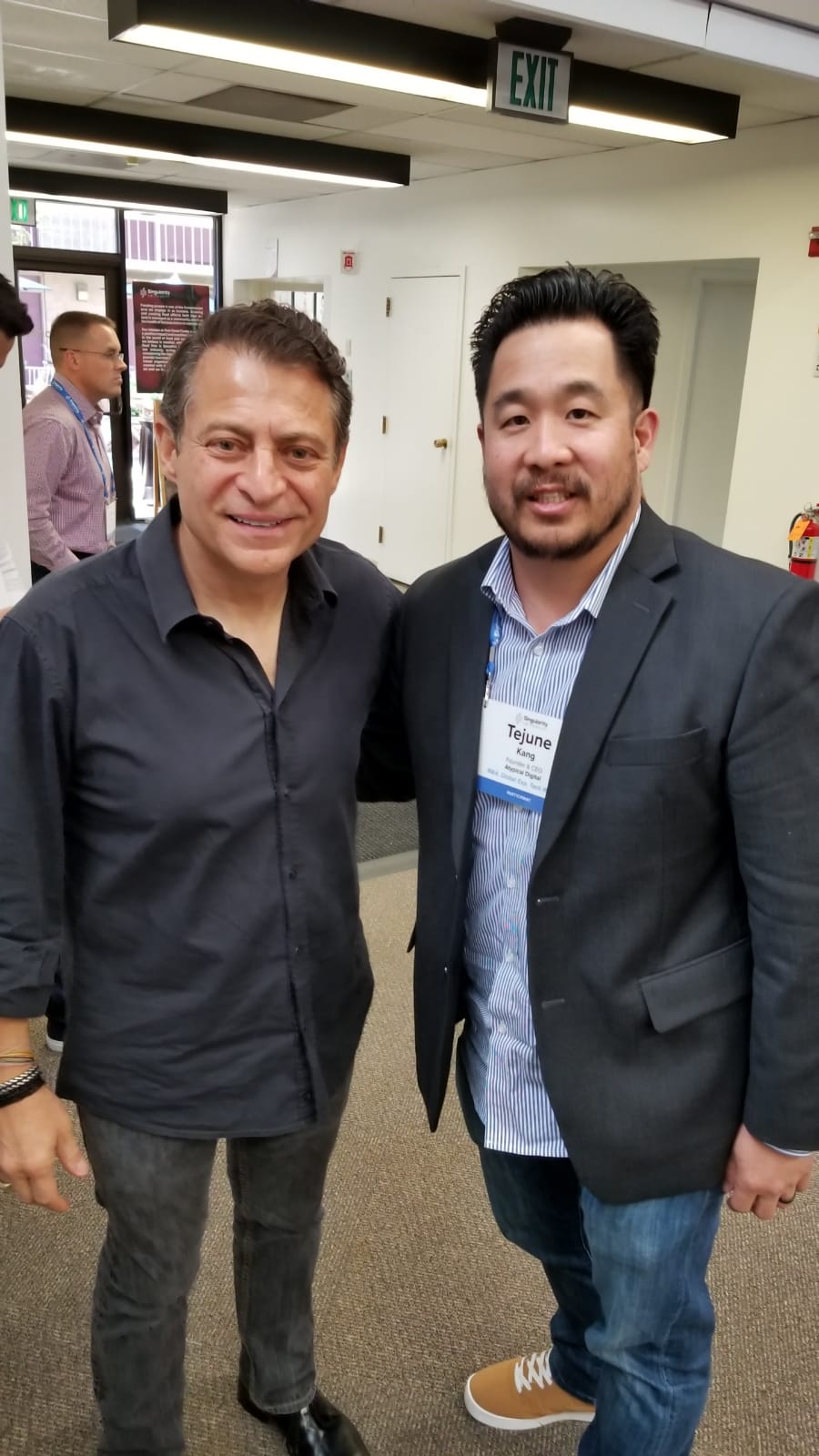
The thing nobody tells you about going public
Going public is the most public thing you'll ever do. Everybody sees the bell. Everybody sees the ticker. Everybody sees the press release.
What nobody sees is the private chapter that comes after — the part where you have to ask yourself a much harder question than "did we hit the open." The question is: now what?
Most public-company founders I know treat the IPO as the climax. They keep grinding the same playbook that got them there. New quarter, new guidance, new earnings call. Same operating instincts.
That's what almost every late-stage founder does, and it's wrong.
The IPO is a checkpoint, not a climax. The instincts that get you to the bell are not the same instincts that compound for the next 20 years. The chair changes. The audience changes. The questions change. If you don't change with them, the next chapter writes itself — and not in your favor.
Why I went to Singularity
I went to Singularity in 2018 for a specific reason. I'd just spent five years inside the public-company machine — SEC filings, investor calls, board governance, analyst expectations. I knew what I knew. What I needed to find out was what I didn't know.
Specifically: where the next decade was actually going. Not the consensus answer that every conference circuit panel was repeating. The actual answer.
Diamandis runs Singularity around one provocative claim — that exponential technologies compound, and the operators who internalize that compounding earlier outperform the ones who don't. Not by a little. By orders of magnitude.
I went in skeptical. I came out converted. Not because of any single insight he delivered — but because of how the room was constructed. The room was full of operators who had already made their first fortune and were obsessed with the next 20 years. Nobody was performing. Everybody was learning.
The three things I keep going back to
I've been out of Singularity for a few years now and I run a quiet ledger of what I actually use from that program. Most of what I learned was scaffolding I forgot. Three things stuck.
1. AI is not a feature — it's a force multiplier
This sounds obvious in 2026. It was not obvious in 2018. Diamandis was emphatic about it then in a way most operators dismissed. "You will run a 10-person company that does the work of a 100-person company within five years." Verbatim quote, from 2018.
He was right, and most of the operators I knew at the time who heard the same talk didn't act on it. They added "AI" to their pitch decks. They didn't rebuild their operating model around it. The ones who did rebuild — quietly, between 2018 and 2022 — are the ones running the leanest, fastest companies right now. The ones who didn't are still adding "AI" to their pitch decks.
2. The longevity argument is real
Diamandis spends a lot of time on longevity. Most operators write it off as Bay Area mysticism. I'd argue they're wrong, and not in the way you think.
The argument isn't that you're going to live to 150. The argument is that the discount rate on long-term decisions changes when you internalize that you might have 30+ productive years left. If you're 47 and you assume you've got 15 working years, you optimize for the next deal. If you assume you've got 30, you optimize for the next platform. Different operating model. Different patience curve. Different bets.
Most founders I work with are operating on the 15-year clock without realizing it. Their pricing decisions, hiring decisions, and exit decisions are all 15-year decisions. That's the single biggest thing I push back on in advisor calls.
3. The "rooms" matter more than the credentials
This is the one that surprised me most. Diamandis himself doesn't optimize for credentials anymore — he optimizes for rooms. What rooms are you in. Who else is in them. What's getting decided there.
He told me one thing offhand that I think about almost weekly: "The credential gets you the first invitation. The contribution gets you the second."
I've watched that be true now in dozens of subsequent rooms. YPO panels at the NYSE. The Fast 50 Asian American Business gala where I met Indra Nooyi. The HBS event where I ended up next to Tilman Fertitta. The Necker dinner with Sir Richard Branson. None of those rooms cared about the IPO once I was in them. They cared about whether I had something useful to contribute.
What the operator audience usually misses
When I tell this story to founders I'm advising, the part they usually grab onto is the credential — Singularity, Diamandis, the AI thesis. That's the wrong part.
The right part is the structural answer to "now what?" If you're a founder reading this and you're optimizing for the next checkpoint — the Series B, the secondary, the IPO, the exit — you're already missing the more important question. The more important question is: what are you optimizing for after the checkpoint clears?
If the answer isn't already in your head, you don't have a strategy. You have a sprint. And sprints don't compound.
The IPO was chapter one. The work after the IPO is the work that compounds. If your strategy ends at the bell, your strategy is too short.
That's the honest answer to "what did you do after the IPO." I went to Singularity. I sat in a room. I changed my time horizon. And I started building the next 20 years.
Most operators never get the second invitation because they were too busy celebrating the first. Don't be that operator.